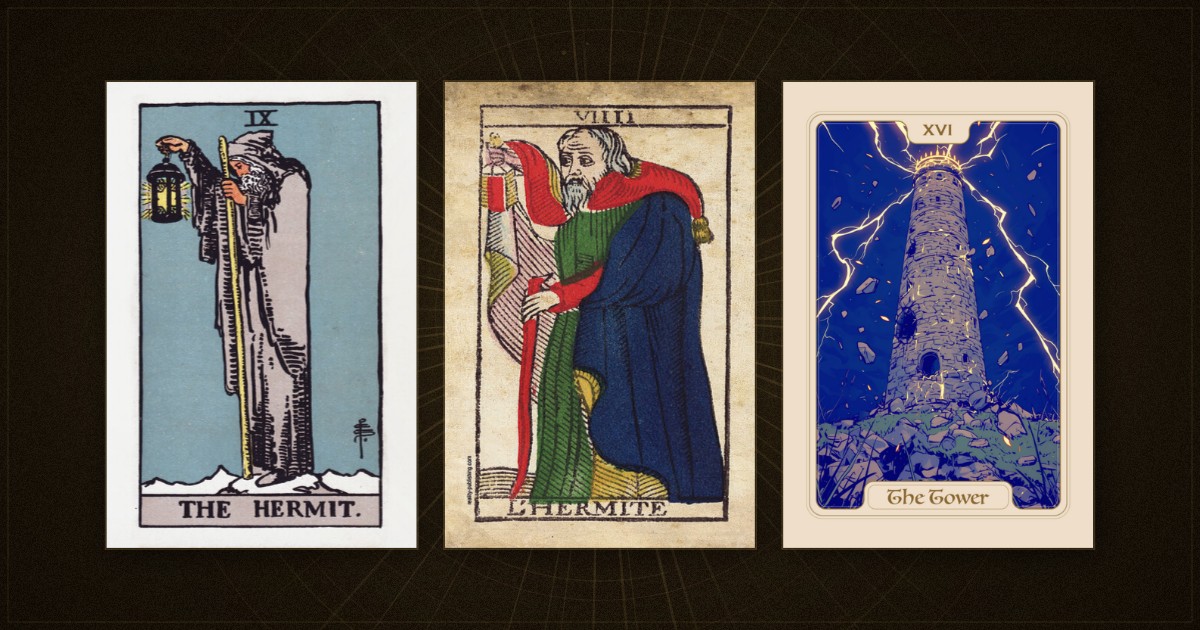
When the Cards Repeat Themselves
You shuffle thoroughly. You draw a card. You draw The Hermit. The next morning, you shuffle again — different question, fresh deck — and you draw The Hermit. A few days later, there it is again.
This is one of the most common questions experienced tarot readers get: why do I keep drawing the same card? It feels uncanny, sometimes unsettling. The temptation is to dismiss it as coincidence or to read too much into it.
The truthful answer is in between. Recurring cards are real, meaningful, and worth paying attention to — but they’re not magic.
- Drawing the same tarot card repeatedly usually means there's a theme in your life you haven't fully addressed. The card recurs because the lesson hasn't been integrated.
- Recurring cards are statistically possible but psychologically meaningful. Your subconscious primes you to notice the same patterns until you act on them.
- The most common recurring cards are the Major Arcana — particularly The Tower, The Hermit, Death, and The Hanged Man — because they represent unresolved life themes.
- If a card appears 3+ times in a short period, treat it as a directive, not a coincidence. The cards are flagging something specific.
- The recurring card stops appearing once you've genuinely engaged with its message — not necessarily solved the problem, but acknowledged it consciously.
The Statistical Reality
In a 78-card deck, the odds of drawing the same card twice in a row are 1 in 78 — about 1.3%. The odds of drawing it three times in a week of daily readings are higher than people assume. Coincidence is genuinely possible.
But here’s the thing: most people don’t notice random repeats of unimportant cards. You don’t write to your tarot reader about drawing the Five of Pentacles twice. You write because you keep drawing The Tower during a stressful time, or The Hermit when you’ve been feeling isolated, or Death when you sense something needs to end.
The repetition you notice is the repetition that matters.
Why Your Subconscious Surfaces the Same Card
Tarot works partly through unconscious pattern recognition. When you shuffle and draw, you’re not making a purely random selection — your hand pauses, lifts, separates the deck in patterns subtly influenced by tactile memory, micro-tensions, and intuitive cues.
This isn’t supernatural. It’s the same mechanism that makes you “find” your keys after staring at the table for thirty seconds — your brain has been processing visual information you weren’t consciously aware of.
When a theme dominates your inner life, your hand draws toward cards that match. The card doesn’t appear by chance; it appears because you’re already thinking about what it represents, even if you haven’t named it consciously yet.
Common Recurring Cards and What They Usually Mean
The Tower repeating
A change you’ve been resisting is becoming inevitable. The Tower keeps appearing because you keep refusing to acknowledge what’s already crumbling.
The Hermit repeating
You need solitude that you haven’t been allowing yourself. Or you’ve been isolating in unhealthy ways and the card is naming what you’ve been doing rather than affirming it.
Death repeating
A transformation you’ve been delaying. Something needs to end — a relationship, a job, an identity, a habit — and you’ve been stalling.
The Hanged Man repeating
You’re stuck in a holding pattern. The card keeps appearing because you keep refusing to surrender or shift perspective on whatever has you frozen.
The Moon repeating
There’s something you can’t see clearly. Persistent confusion, ambivalence, or self-deception that you haven’t yet looked at directly.
The Lovers repeating
A choice you’ve been avoiding, particularly one involving values. Often relationship-related but can also be career or identity-based.
Three of Swords repeating
Unprocessed grief or heartbreak. The pain is asking for acknowledgment, not avoidance.
Eight of Cups repeating
You know you need to walk away from something but you haven’t. The card returns until you take the step.
How Many Times Counts as “Repeating”?
Loose guidelines:
- Twice in a row: Could be coincidence. Note it but don’t overinterpret.
- 2-3 times in a week: A theme worth examining.
- 3+ times in a week, or 5+ times in a month: Treat as a directive. The cards are flagging this for a reason.
- Same card across different spreads or different question contexts: Especially significant. The card is the constant; your questions are the variable. The card is responding to something deeper than any individual question.
How to Read a Recurring Card
When you notice a card recurring, work through this:
Step 1: Acknowledge the pattern
Just naming “this card has appeared three times this week” begins the process. You can’t act on a pattern you don’t see.
Step 2: Ask what you’ve been avoiding
Recurring cards almost always point at something you know but haven’t faced. Not in a dramatic way — often just something you’ve been pushing aside because it’s inconvenient.
Step 3: Look at the card’s specific message
Cards repeat because their core message hasn’t landed. Re-read the card’s meaning slowly. What part of it do you keep skipping over?
Step 4: Take one small action
The recurring card stops once you’ve engaged with its message — not necessarily solved the problem, but acknowledged it. A journal entry, a conversation, a single decision.
Step 5: Watch what happens
Often, after you genuinely act on a recurring card, it stops appearing. A different card takes its place — usually one that reflects the next step in the journey.
The “Card of the Week” or “Card of the Year”
Some readers experience recurring cards over much longer timeframes — a card that keeps appearing across months or even an entire year. These often represent overarching life themes:
- A “card of the year” might emerge during a period of major life transition, returning during pivotal moments to anchor you
- A recurring birth card reflects ongoing engagement with your life-path themes
- The same card appearing at meaningful moments (job interviews, anniversaries, hard conversations) often signals that this theme is your work right now
You don’t need to do anything special with these long-arc recurring cards. Just notice them, name them, and let them inform how you think about the season you’re in.
What Recurring Cards Are NOT
A few important clarifications:
They’re not predictions. A recurring Death card doesn’t mean someone is going to die. Death in tarot is transformation, almost always.
They’re not punishment. The cards aren’t “trying to tell you” something with menace. They’re surfacing patterns. The same card appearing 5 times is not a warning of doom.
They’re not infallible. Sometimes a card just keeps coming up because you’ve been thinking about it, or because of how you shuffle, or genuine randomness. Not every repeat needs deep interpretation.
They’re not a substitute for action. Recognizing a pattern only helps if you act on the recognition. Endlessly noting “I keep drawing The Tower” without examining why is just rumination in tarot drag.
When to Stop a Recurring Card Pattern
If a card has appeared multiple times and you’ve genuinely engaged with the message but it keeps returning, consider these possibilities:
- You’re partially engaged but not fully. You’ve thought about the message but haven’t taken any action that reflects it.
- You’re solving the surface but not the root. The card is pointing at a deeper issue than you’ve identified.
- You’re projecting. You’ve decided in advance what the card means and you’re filtering everything through that lens.
- You’re shuffling identically every time. Tactile habits can produce statistical clustering. Try a different shuffle method.
- It really is your card right now. Some cards stay with you for a season. The Hermit might be your card for the next three months. That’s not a problem; that’s information.
How The Cards Know Surfaces Patterns
A daily tarot practice with The Cards Know automatically tracks your reading history, making recurring patterns visible at a glance. After a week of daily readings, you can see exactly which cards have appeared multiple times and which themes are running through your practice — without manually keeping track.
Most users report that by week three, the patterns are obvious. By week six, they’ve started to act on them.
Frequently Asked Questions
Why do I keep drawing the same tarot card every day? Because there’s a theme in your life that hasn’t been fully integrated. Recurring cards reflect unresolved patterns your subconscious is processing. The card returns until the message is acknowledged.
Is it bad luck to draw the same card repeatedly? No. Recurring cards are not warnings or curses. They are patterns reflecting something you’re working through.
How many times does a card need to repeat before it’s significant? Three or more appearances in a short period (a week or two) usually indicates a meaningful pattern worth examining. Twice could be coincidence.
Will the card stop appearing once I figure out what it means? Usually, yes. Once you’ve genuinely engaged with the card’s message — not just understood it intellectually but acted on it — it tends to stop appearing.
Can a recurring card mean something different each time? The core meaning stays consistent, but the specific application can shift as you engage with it. The Tower might initially point to one collapsing situation, then later point to a different unstable area as you address the first one.
What if the same card keeps appearing in tarot readings done by different people? Especially significant. If multiple readers (or multiple decks) consistently produce the same card around a question, the message is unmistakable. Take it seriously.
The cards repeat for a reason. Not magic — pattern. Your job is to listen.